

Artifacts are in beta. They require a Team or Enterprise plan and a session signed in with
/login. See Availability for the full set of requirements.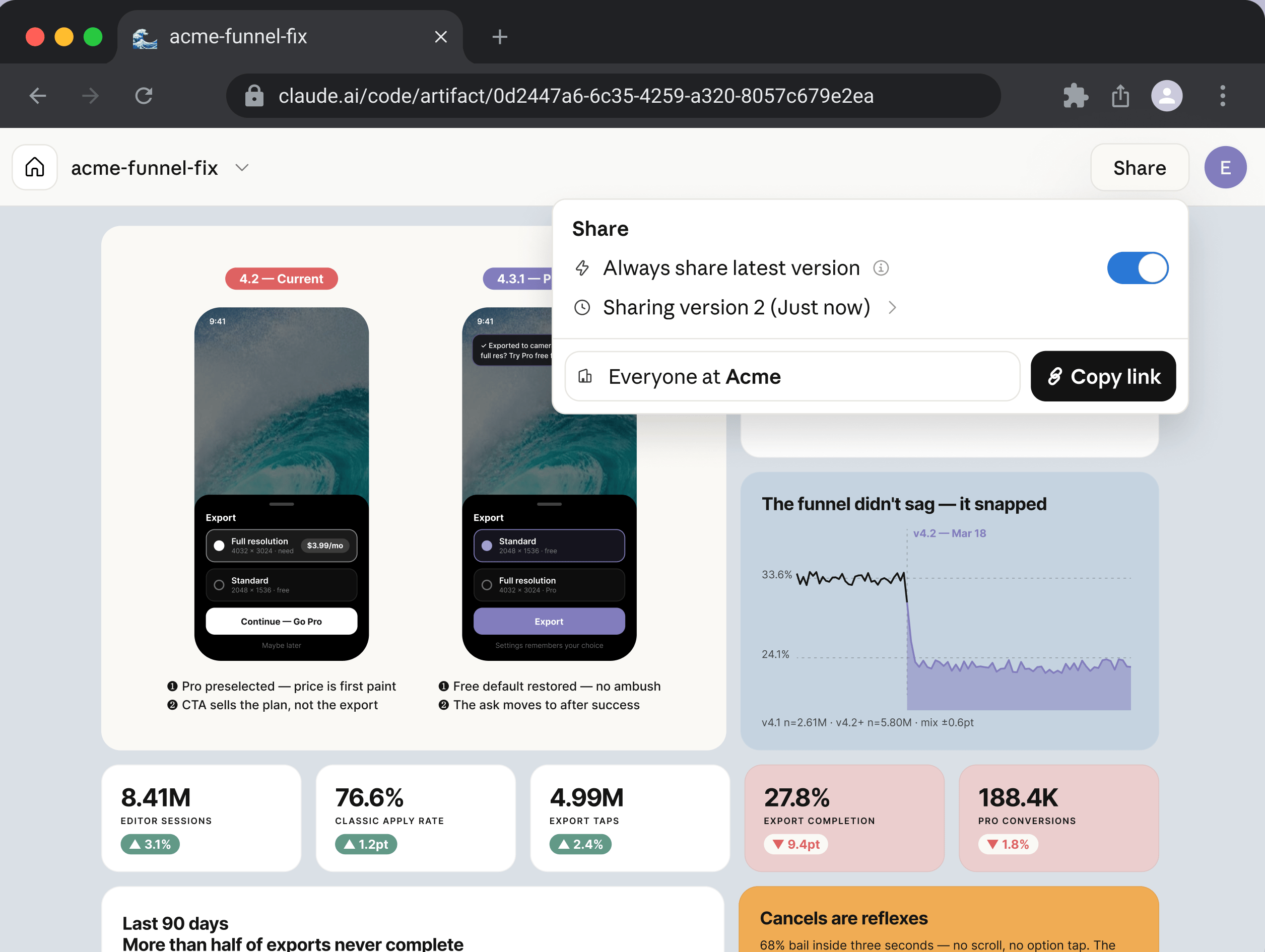
- Decide when to use an artifact
- Create, update, and share an artifact
- Apply prompting patterns for richer pages
- Apply your own design system so artifacts match your product’s branding
- Understand the page constraints and availability requirements
- Disable or manage artifacts for your organization
When to use an artifact
Use an artifact when terminal text is the wrong medium for what Claude produced: output that is easier to look at and interact with than to read line by line. Claude builds the page from anything your session can reach, including your codebase and data it pulls through your connected tools, so the page can show things that would take paragraphs to describe. For example, ask Claude to:- Walk a reviewer through a pull request with annotated diffs
- Render a dashboard from data the session already pulled
- Lay out several design or implementation options side by side
- Keep an investigation timeline that fills in while a long task runs
- Send a teammate a link instead of pasting output into Slack
What an artifact is not
An artifact is a capture of work, not an application. It is one self-contained page with no backend, so it cannot store form input, call an API at view time, or serve multiple routes. For a hosted internal tool with a backend, deploy it on your own infrastructure instead. See Page constraints for the full set of limits.Create an artifact
Claude may publish an artifact on its own when the output suits a page, or you can ask for one directly. To ask, name the feature or describe the visual output you want in plain language. A good candidate is anything easier to see than to read as text, such as an annotated diff, a chart, or a set of options to compare. The prompts below are two examples; see What you can build for more patterns.Claude wants to publish "Deploy failures by service" (deploy-failures.html) to a private page on claude.ai. Republishing an artifact you have already approved does not prompt again.
Select Yes to publish. Claude prints the URL, and your browser opens to the new page. Press Ctrl+] at any time to reopen the most recent artifact from the terminal.
Claude picks the artifact’s title and an emoji for its browser-tab icon. Both appear in your gallery of artifacts on claude.ai and in shared links, so ask Claude to use a specific title or icon if you want one.
To stop the browser from opening automatically when a new artifact is published, set CLAUDE_CODE_ARTIFACT_AUTO_OPEN=0 in your environment.
If Claude responds that it cannot publish, or writes a local HTML file without a link, the tool is not enabled for your session. Check the Availability requirements.
Update an artifact
Ask Claude to revise the page, or let a long-running task republish as it makes progress. Claude edits the underlying file and publishes again to the same URL.Share an artifact
A new artifact is visible only to you. Open it in your browser and use the Share control in the page header to grant access to specific people in your organization, or to everyone in it. The header names you as the artifact’s author, so anyone you share it with can see who published the page. It also links to your gallery at claude.ai/code/artifacts, which lists every artifact you have created. Sharing stops at your organization. Viewers must sign in to claude.ai as a member of the same organization that published the artifact, and there is no option to make an artifact viewable outside it. To send the underlying content to someone outside your organization, ask Claude for the HTML file and share that file directly. Artifacts are viewable, not co-edited. People you share with see each version you publish but cannot change the page; you remain the only writer.What you can build
An artifact is a single HTML page, so anything you can express in HTML, CSS, and inline JavaScript is in scope. The patterns below come up most often.Walk through a change
Ask for a page that renders a diff or a design change with annotations beside the relevant lines, so reviewers can read your reasoning next to the code instead of reconstructing it from a description.Compare alternatives
Ask for several variants on one page so you can evaluate them against each other. This works for layouts, copy, API shapes, or implementation plans.Tune with interactive controls
Ask for sliders, toggles, or input fields bound to whatever you are adjusting, so you can explore values directly instead of describing them.Bring the result back to your session
An artifact can act as a lightweight editor for a decision you then hand back to Claude. Ask for an export control that produces text you can paste into the terminal, so the result of interacting with the page flows back into the session instead of staying on the page.Track work in progress
Ask Claude to keep an artifact current while a long task runs, so anyone with the link can follow along without reading the terminal.Improve the visual design
Claude applies a built-in design skill when it builds an artifact, so pages get a deliberate palette, typography, and layout without extra prompting. That skill also looks for an existing design system in your project before choosing its own. To keep artifacts consistent with your product’s branding, record your design tokens where Claude can find them, such as the project’s CLAUDE.md or a theme file in your repository:Page constraints
Each artifact is one self-contained page. Claude Code wraps the file you publish in an HTML document shell and serves it under a strict Content Security Policy (CSP), which shapes what the page can do.| Constraint | Effect |
|---|---|
| No external requests | The CSP blocks scripts, stylesheets, fonts, and images loaded from any other host, along with fetch, XHR, and WebSocket calls. Claude inlines CSS and JavaScript and embeds images as data URIs so the page renders without any external request. |
| No backend | An artifact is a static page. It cannot store data submitted through a form, authenticate viewers itself, or call an API at view time. |
| Single page | Relative links do not resolve, because nothing is deployed alongside the page. For multi-section content, Claude uses in-page anchors rather than separate files. |
| Source file types | The published file must be .html, .htm, or .md. Markdown files render as styled HTML. |
| Rendered size | The rendered page must be 16 MiB or smaller. Large embedded images are the usual cause when a publish fails for size. |
- Prefer SVG, or HTML and CSS, for diagrams over embedded raster images
- Omit interactivity you do not need
- Have the page summarize large datasets rather than inline them in full
Availability
Artifacts require every condition below. When one is not met, Claude writes a local HTML file or says it cannot publish instead.| Requirement | Available when |
|---|---|
| Plan | Team or Enterprise. On Team plans, artifacts are on by default. On Enterprise plans, an admin enables them in claude.ai admin settings. |
| Authentication | Signed in to claude.ai with /login. Sessions using an API key, gateway token, or cloud-provider credential cannot publish. |
| Model provider | Anthropic API. Not available on Amazon Bedrock, Google Cloud Vertex AI, or Microsoft Foundry. |
| Organization policy | Customer-managed encryption keys (CMEK), HIPAA, and Zero Data Retention are not enabled for the organization. |
| Surface | Claude Code CLI, or the Claude desktop app version 1.13576.0 or later. Off by default in Agent SDK, GitHub Action, and MCP-server contexts, and when CLAUDE_CODE_DISABLE_NONESSENTIAL_TRAFFIC is set. |
Disable artifacts
To turn artifacts off for your own sessions regardless of your organization’s setting, use any of:| Method | Setting |
|---|---|
| Settings file | "disableArtifact": true |
| Environment variable | CLAUDE_CODE_DISABLE_ARTIFACT=1 |
| Permission rule | Add Artifact to permissions.deny |
Manage artifacts for your organization
Admins on Team and Enterprise plans control artifacts from claude.ai admin settings. Artifact content is stored on Anthropic-operated infrastructure and is visible only to authenticated members of the publishing organization.Enable or disable artifacts
To enable or disable artifacts for the whole organization, go to Settings > Claude Code > Capabilities and use the Artifacts toggle. On Enterprise plans with role-based access control, you can additionally scope artifacts to specific roles: go to Settings > Roles, edit a role, and set the Artifacts permission under the Claude Code group.Set a retention policy
To set how long artifacts are kept before automatic deletion, go to Settings > Data & privacy controls. You can set separate retention periods for artifacts that are still private to their author and artifacts that have been shared.Review the audit log
Publishing, sharing, and deleting an artifact each appear in your organization’s audit log under theclaude_artifact_* event types, the same family used for artifacts created in claude.ai conversations.
Allowlist the viewer domain
The viewer on claude.ai loads each artifact from a sandboxed*.claudeusercontent.com origin. If your organization restricts outbound network access, add that domain to your allowlist alongside claude.ai. See Network access requirements for the full list.
List and delete artifacts with the Compliance API
The Compliance API provides endpoints to list an organization’s artifacts, retrieve a specific version’s content, and delete an artifact:| Method | Endpoint |
|---|---|
GET | /v1/compliance/code/artifacts |
GET | /v1/compliance/code/artifacts/{artifact_id}/versions/{version_id} |
DELETE | /v1/compliance/code/artifacts/{artifact_id} |
Related resources
- Browse prompting patterns and workflows that pair with artifacts
- Turn an artifact prompt you reuse into a skill so you can invoke it as a command
- Connect MCP servers so Claude can pull live data into an artifact