

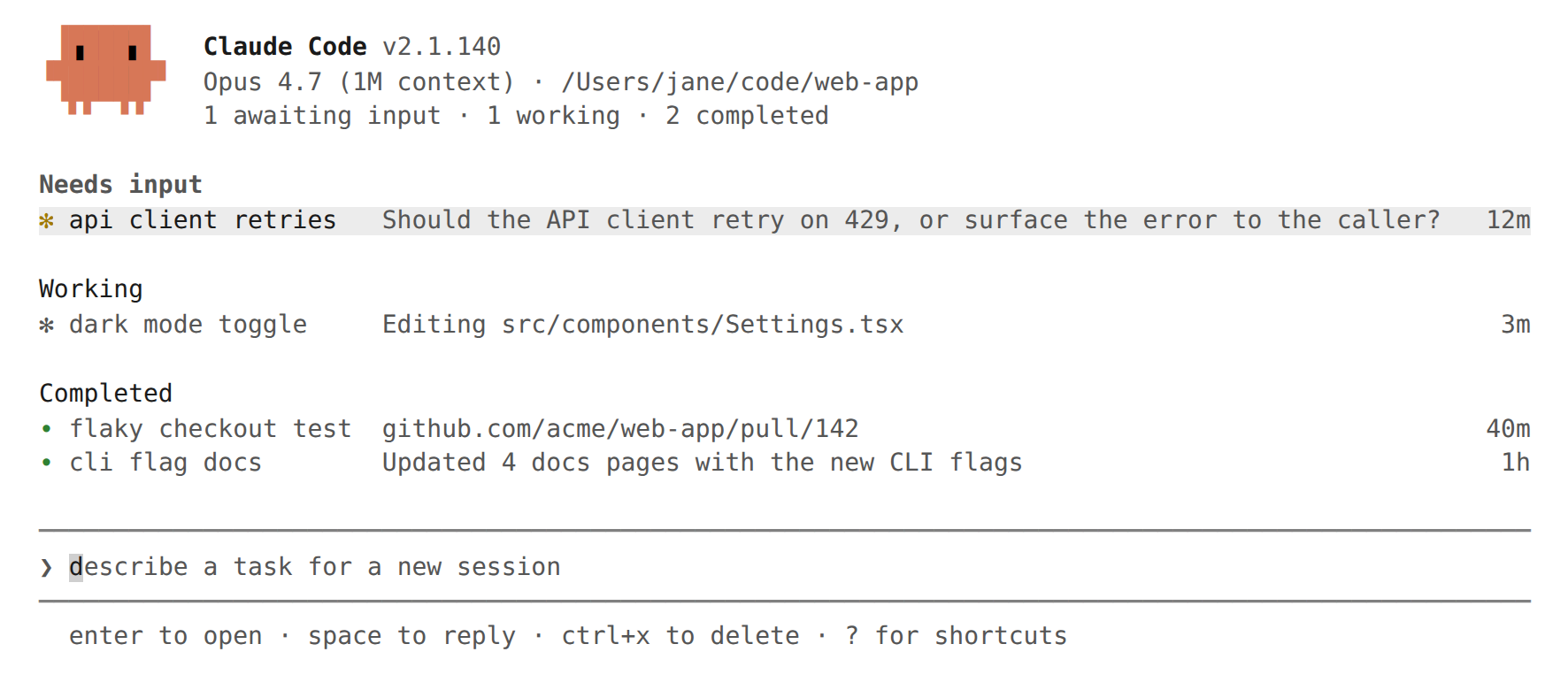
claude agents, is one screen for all your background sessions: what’s running, what needs your input, and what’s done. Dispatch new sessions, watch their state at a glance instead of scrolling through transcripts, and step in only when one needs you. Each background session is a full Claude Code conversation that keeps running without a terminal attached, so you can open it, reply, and leave whenever you want.
Agent view is in research preview and requires Claude Code v2.1.139 or later. Check your version with
claude --version. The interface and keyboard shortcuts may change as the feature evolves.- Quick start: give Claude a task to work on in the background, check on it, and step in when needed
- Monitor sessions with agent view, including state icons, peeking and replying, attaching, organizing, and keyboard shortcuts
- Dispatch new agents from agent view, from inside a session, or from your shell
- Manage sessions from the shell
- How background sessions are hosted by the supervisor process
Quick start
This walkthrough covers the core agent view loop: dispatch a task, watch its row update as Claude works, peek to check on it and reply, and attach for the full conversation. The session you dispatch keeps running after you close agent view, so you can leave and come back to it.Open agent view
From your shell, run:Agent view opens with an input at the bottom and a table that fills in as sessions start. Press
Esc at any time to return to your shell. Your sessions keep running while you’re away and reappear the next time you open agent view.Dispatch a session
Type a prompt describing a task and press
Enter. A new background session starts on that task and appears as a row showing whether it’s working, waiting on you, or done. The new session uses the model shown in the agent view header and the same permission mode you’d get running claude in that directory.Every prompt you enter here starts its own new session. Typing another prompt and pressing Enter launches a second session alongside the first rather than sending a follow-up to it. You can run several in parallel this way.Each session uses your subscription quota independently, so see Limitations before dispatching many at once.Peek and reply
Select a row with the arrow keys and press
Space to open the peek panel. It shows the session’s most recent output, or the question it’s waiting on, rather than the full transcript. Type a reply and press Enter to send it without leaving agent view.Attach and detach
Press
Enter or → on a row to attach when you want the full conversation. The session takes over the terminal as a full interactive Claude Code session. Press ← on an empty prompt to detach and return to the table.claude agents as your primary entry point instead of claude: dispatch every task from agent view, attach when you want the full conversation, and press ← to return to the table.
Monitor sessions with agent view
Runclaude agents to open agent view. It takes over the full terminal and lists every session grouped by state, with pinned sessions and the ones that need you at the top. Each row shows the session’s name, current activity, and how long ago it last changed.
By default the list shows every background session you’ve started, across all your projects. A session working in one repository and another in a different worktree both appear here, regardless of which directory you opened agent view from. To narrow the list to one project, pass --cwd (requires Claude Code v2.1.141 or later):
~/projects/my-app/.claude/worktrees/ still counts as belonging to ~/projects/my-app.
Interactive sessions you have open in other terminals don’t appear until you background them. Subagents and teammates a session spawns aren’t listed as separate rows.
Read session state
Each row starts with an icon whose color and animation show the session’s state:| State | Icon shows as | What it means |
|---|---|---|
| Working | Animated | Claude is actively running tools or generating a response |
| Needs input | Yellow | Claude is waiting on a specific question or permission decision from you |
| Idle | Dimmed | The session has nothing to do and is ready for your next prompt |
| Completed | Green | The task finished successfully |
| Failed | Red | The task ended with an error |
| Stopped | Grey | The session was stopped with Ctrl+X or claude stop |
| Shape | What it means |
|---|---|
✻ or animated ✽ | The session process is alive and replies immediately |
∙ | The process has exited. You can still peek, reply, or attach, and Claude restarts from where it left off |
✢ | A /loop session sleeping between iterations. The row shows its run count and a countdown |
PR #N label that can appear at the right edge of a row is the pull request the session opened, not part of the state icon. When a session has opened more than one pull request, the label shows a count instead, such as 3 PRs.
The terminal tab title shows the awaiting-input count while agent view is open: 2 awaiting input · claude agents when sessions need input, or claude agents when none do.
Background sessions don’t need any terminal open to keep working. A separate supervisor process runs them, so you can close agent view, close your shell, or start a new interactive session and your dispatched work keeps going.
Session state persists on disk through auto-updates and supervisor restarts. Sessions are also preserved when your machine sleeps. Their processes resume on wake and the supervisor reconnects to them instead of treating the time gap as idle. Shutting down still stops running sessions; see Sessions show as failed after shutdown for how to recover them.
Row summaries
The one-line summary in each row is generated by a Haiku-class model so the row can tell you what the session is doing, what it needs, or what it produced without opening the transcript. While a session is actively working, the summary refreshes at most once every 15 seconds, plus once when each turn ends. From v2.1.161, when the session is running two or more parallel work items, such as subagents, background shell commands, or monitors, adone/total count such as 2/5 appears before the summary text.
Each refresh is one short Haiku-class request through your normal provider, billed and handled under the same data usage terms as the session itself. On third-party providers such as Bedrock, Vertex AI, Microsoft Foundry, and custom gateways, the request falls back to the session’s main model when no Haiku model is configured. Set ANTHROPIC_DEFAULT_HAIKU_MODEL to choose the model for these summaries on those providers.
Pull request status
When a session opens a pull request, aPR #1234 label appears at the right edge of the row, linked to the pull request in terminals that support hyperlinks. The label persists when you send a follow-up to the session, so the pull request remains visible while the row reverts to live progress.
When a session has opened more than one pull request, the label shows a count instead, such as 3 PRs, colored by the open pull request that most needs attention. Open the peek panel to see them all.
The pull request number is colored by its status:
| Color | Pull request status |
|---|---|
| Yellow | Waiting on checks or review, or checks failed |
| Green | Checks passed and no review is blocking |
| Purple | Merged |
| Grey | Draft or closed |
Peek and reply
PressSpace on a selected row to open the peek panel. It shows what the session needs from you, its most recent output, and any pull requests it opened. Most of the time this is enough, and you never need to open the full transcript.
From v2.1.161, when the session is running parallel work items, the panel also names the longest-running one and how long it has been going, so you can see what the session is waiting on without attaching.
Type a reply in the peek panel and press Enter to send it to that session. When the session is asking a multiple-choice question, the peek panel shows the options and you can press a number key to pick one. For other blocked sessions, press Tab to fill the input with a suggested reply you can edit before sending. Prefix a reply with ! to send a Bash command instead.
From v2.1.145, with voice dictation enabled, hold or tap your push-to-talk key while the reply input is focused to dictate a reply instead of typing it. The same works in the dispatch input at the bottom of agent view.
Use ↑ and ↓ to peek at adjacent sessions without closing the panel, or → to attach.
Attach to a session
PressEnter or → on a selected row to attach. Agent view is replaced by the full interactive session. When you attach, Claude posts a short recap of what happened while you were away.
While attached, the session behaves like any other Claude Code session: every command, keyboard shortcut, and feature works.
Attached sessions always render in fullscreen mode, regardless of your tui setting, because a background session has no terminal scrollback to append to. Scroll with PgUp, PgDn, or the mouse wheel, and press Ctrl+O for transcript mode. Your terminal’s native scroll and tmux copy mode show only the current viewport, the same as when you run any fullscreen application.
Press ← on an empty prompt to detach and return to agent view. If a dialog has focus and isn’t responding to ←, press Ctrl+Z to detach immediately.
Ctrl+C keeps its standard interrupt behavior while attached: it cancels a running response or ! shell command rather than detaching. Pressing Ctrl+C twice on an empty prompt detaches, the same as in any session.
Detaching never stops a background session: ←, Ctrl+Z, /exit, and double Ctrl+C or double Ctrl+D all leave it running. To end a session from inside it, run /stop.
Pressing ← on an empty prompt works from any Claude Code session, not only ones you attached to from agent view. It backgrounds the current session and opens agent view with that row selected, so you can switch sessions without leaving the terminal. The row is created even from a fresh session with no conversation history, so → returns to it. When that row is the only one, agent view shows an onboarding hint below it. You can turn this shortcut off in /config (the leftArrowOpensAgents setting).
Organize the list
Agent view groups sessions so the ones that need input are at the top, withReady for review and Needs input above Working and Completed. These group names don’t map one-to-one to the states above: a session moves to Ready for review when it has an open pull request, and Completed collects finished, failed, and stopped sessions together. Press Ctrl+S to group by directory instead. Your choice persists across runs.
Within a group:
- Press
Ctrl+Tto pin a session to the top and keep its process running while idle - Press
Shift+↑orShift+↓to reorder sessions - Press
Ctrl+Rto rename a session - Press
Enteron a group header to collapse it
Ctrl+X to stop it and Ctrl+X again within two seconds to delete it. Pressing Ctrl+X on a group header deletes every session in that group after confirmation.
Deleting removes the session from agent view. If Claude created a worktree for the session, deleting removes that worktree too, including any uncommitted changes in it, so push or commit work you want to keep first. A worktree you created yourself and started the session inside is left in place. The conversation transcript stays on your local machine and remains available through claude --resume.
Older completed sessions fold into a … N more row to keep the list short. Failures and sessions with an open pull request always stay visible.
Filter sessions
Type in the dispatch input to filter instead of dispatching:| Filter | Shows |
|---|---|
a:<name> | Sessions running the named agent |
s:<state> | Sessions in the given state, such as s:working. Also accepts s:blocked for everything waiting on you |
#<number> or a PR URL | The session working on that pull request |
Keyboard shortcuts
Press? in agent view to see every shortcut in context. The table below summarizes them.
| Shortcut | Action |
|---|---|
↑ / ↓ | Move between rows |
Enter | Attach to the selected session, or dispatch if there’s text in the input |
Space | Open or close the peek panel for the selected session |
Shift+Enter | Dispatch and attach immediately |
→ | Attach to the selected session |
Alt+1..Alt+9 | Attach to session 1–9 in the focused session’s directory |
Tab | On an empty input, browse all subagents. Otherwise apply the highlighted suggestion |
Ctrl+S | Switch grouping between state and directory |
Ctrl+T | Pin or unpin the selected session |
Ctrl+R | Rename the selected session |
Ctrl+G | Open the dispatch prompt in your $VISUAL or $EDITOR |
Ctrl+X | Stop the session; press again within two seconds to delete it |
Shift+↑ / Shift+↓ | Reorder the selected session |
Esc | Close the peek panel, clear the input, or exit |
Ctrl+C | Clear the input; press twice to exit |
? | Show all shortcuts |
Dispatch new agents
You can dispatch new background sessions from agent view, send an existing interactive session to the background, or start one directly from the shell.From agent view
Type a prompt in the input at the bottom of agent view and pressEnter to start a new background session. The session is named automatically from the prompt; rename it later with Ctrl+R.
Paste an image into the prompt to include a screenshot or diagram with the task.
Prefix or mention parts of the prompt to control how the session starts:
| Input | Effect |
|---|---|
<agent-name> <prompt> | If the first word matches a custom subagent name, that subagent runs as the session’s main agent with the configuration from its frontmatter |
@<agent-name> | Mention a custom subagent anywhere in the prompt to run it as the main agent |
@<repo> | Mention a repository under the directory you opened agent view from to run the session there |
/<command> | Suggest skills and commands to dispatch as the prompt |
! <command> | Run a shell command as a background job instead of starting a Claude session. The job appears as a row you can attach to, watch, and detach from |
#<number> or a pull request URL | If a session is already working on that PR, select it instead of dispatching |
Shift+Enter | Dispatch and immediately attach to the new session |
/exit and /quit close agent view, and /logout signs you out. Every other command and skill is sent to a new background session as its first prompt.
Packaging a recurring task as a skill lets you start the same workflow from agent view repeatedly without retyping the prompt.
When the same @name matches both a subagent and a sibling repository, the subagent takes precedence. The bare first-word match also applies, so a prompt that happens to begin with one of your subagent names dispatches that subagent rather than treating the word as plain text. Use the @ form when you want to be explicit, or start the prompt with a different word to avoid the match.
Dispatch to a specific directory
A new session runs in the directory you opened agent view from. To target a different directory:- Open
claude agentsin that directory. - Open
claude agentsin a parent directory that holds several repositories and mention one with@<repo>in the prompt to run the session there. - From the shell,
cdinto the directory and runclaude --bg "<prompt>".
From inside a session
Run/background or its alias /bg to move the current conversation into a background session. Pass a prompt such as /bg run the test suite and fix any failures to give one more instruction first. If Claude is responding when you run /bg, the response continues in the background session.
Backgrounding from an interactive session starts a fresh process that resumes from the saved conversation, so running subagents, monitors, and background commands do not transfer to it. Claude asks you to confirm before backgrounding when any are running. Once in the background, the session can start new subagents, monitors, and background commands, and those keep running across later detach and reattach.
Configuration flags from the original launch carry through to the backgrounded session, so its MCP servers, settings, and fallback model remain in effect:
--mcp-configand--strict-mcp-config--settings--add-dir--plugin-dir--fallback-model--allow-dangerously-skip-permissions
/add-dir also carry through.
Carrying --allow-dangerously-skip-permissions through keeps bypassPermissions reachable in the backgrounded session, but it does not grant anything new. The mode still requires the same one-time interactive acceptance described in Permission mode, model, and effort before any session can use it.
From your shell
Pass--bg to start a session that goes straight to the background:
--bg with --agent:
--name to set the session’s display name in agent view instead of the auto-generated one:
--name, the name appears after the short ID:
Run a shell command
To run a shell command as a background job instead of a Claude session, type! as the first character of the agent view dispatch input. The ! shows as a prefix and everything you type after it is the command. The following example dispatches pytest -x from the agent view input box:
Enter to start the job. The same job can also be launched directly from your shell with --exec:
Space to peek without attaching, or run claude logs <id> from your shell. The captured output stays in memory and is not written to disk. The row and its output clean up automatically about five minutes after the command exits, so read it before then if you need the result.
How file edits are isolated
Every background session, whether started from agent view,/bg, or claude --bg, starts in your working directory. Before editing files, Claude moves the session into an isolated git worktree under .claude/worktrees/, so parallel sessions can read the same checkout but each writes to its own.
Claude skips the worktree when:
- The session is already inside a linked git worktree, whether Claude created it under
.claude/worktrees/or you created it withgit worktree addsomewhere else - The working directory isn’t a git repository and no
WorktreeCreatehook is configured - The write is outside the working directory
worktree.bgIsolation to "none". Background sessions then edit your working copy directly without moving into a worktree first. Add the setting to the project’s .claude/settings.json:
The
worktree.bgIsolation setting requires Claude Code v2.1.143 or later.WorktreeCreate hook and Claude isolates edits the same way it does for git.
Deleting a session in agent view (Ctrl+X twice) removes a worktree Claude created for it, including any uncommitted changes, so merge or push the changes you want to keep first. Deleting from the shell with claude rm keeps a worktree that has uncommitted changes and prints its path so you can clean it up yourself. A worktree you created yourself and started the session inside is left in place either way.
To find a session’s worktree path, peek the session or attach and check its working directory.
A subagent the background session spawns inherits the session’s working directory, so its file edits land in the session’s worktree rather than your working copy. To give a subagent its own separate worktree instead, set isolation: worktree in its frontmatter or pass isolation: "worktree" when spawning it.
Set the model
The model name shown in the agent view header is the dispatch default. New sessions you start from the input use this model, which comes from themodel setting in your user settings. Set it by selecting a model in the /model picker, or edit the setting directly. To override it for the whole agent view session, pass --model when opening agent view. See Permission mode, model, and effort.
Each background session can run on a different model. To override it for one session:
- From the shell, pass
--modelwithclaude --bg. - Attach to a running session, open
/model, and pressson a model to switch for that session only. The change persists if the session is respawned. - Dispatch a subagent whose frontmatter sets a
modelfield.
Permission mode, model, and effort
A background session reads its settings from the directory it runs in, the same as if you had startedclaude there.
The permission mode depends on how you started the session. Backgrounding an existing session with /bg or ← keeps the current permission mode, so a session you switched to acceptEdits or auto stays in that mode after detaching. Dispatching from the agent view input or running claude --bg from your shell uses the defaultMode from that directory’s settings, or the permissionMode from the dispatched subagent’s frontmatter.
The permission mode, model, and effort a background session was started with, along with the configuration flags it carries, all persist when the supervisor later stops and restarts its process. A session you launched with claude --bg --dangerously-skip-permissions or claude --bg --permission-mode bypassPermissions stays in bypassPermissions after that restart instead of falling back to the directory’s defaultMode, and a model or effort you changed mid-session with /model or /effort is kept.
To set defaults for every session you dispatch from agent view, pass any of --permission-mode, --model, --effort, or --agent when opening it:
--agent sets the subagent used when a dispatch prompt does not name one, either with @name or as the first word. It defaults to the agent setting if one is set, otherwise the built-in catch-all claude agent. Naming a subagent in the dispatch input overrides both.
claude agents also accepts --dangerously-skip-permissions as shorthand for --permission-mode bypassPermissions, and --allow-dangerously-skip-permissions to make bypassPermissions available in each dispatched session’s Shift+Tab cycle without starting in that mode. Both match the top-level CLI flags.
These flags were added across releases. Earlier versions reject them with an unknown-option error.
| Flag or setting | Minimum version |
|---|---|
--permission-mode, --model, --effort, --dangerously-skip-permissions | v2.1.142 |
--allow-dangerously-skip-permissions | v2.1.143 |
--agent, and honoring the agent setting for dispatched sessions | v2.1.157 |
agent setting and dispatches the built-in claude agent.
The active defaults appear in the footer below the dispatch input.
Without these flags, the session uses the defaultMode from that directory’s settings or the permissionMode from the dispatched subagent’s frontmatter, and the model shown in the agent view header.
Using bypassPermissions or auto is refused until you have accepted that mode by running claude with it once interactively, since those modes let a session you aren’t watching act without approval. The same applies whether you pass the mode to claude agents or to claude --bg --permission-mode.
Settings, plugins, and MCP servers
Agent view accepts the same configuration flags asclaude for loading settings, plugins, MCP servers, and additional directories. These flags require Claude Code v2.1.142 or later. Each flag applies to agent view itself and is passed through to every session you dispatch from it, so a plugin or MCP server you load this way is available in those sessions too.
| Flag | Effect |
|---|---|
--settings <file-or-json> | Override settings for agent view and dispatched sessions |
--add-dir <path> | Grant file access to an additional directory |
--plugin-dir <path> | Load a plugin from a local directory |
--mcp-config <file-or-json> | Load MCP servers from a config file or JSON string |
--strict-mcp-config | Use only the MCP servers from --mcp-config, ignoring other MCP configuration |
--add-dir, --plugin-dir, or --mcp-config once per value. The space-separated form, such as --add-dir a b c, is not supported with claude agents.
The following example opens agent view with a settings override and one extra directory:
Manage sessions from the shell
Every background session has a short ID you can use from the shell. The ID is printed when you start a session withclaude --bg, and each session’s ID is its directory name under ~/.claude/jobs/. These commands are useful for scripting or when you don’t want to open agent view.
| Command | Purpose |
|---|---|
claude agents | Open agent view |
claude agents --cwd <path> | Open agent view scoped to sessions started under <path> |
claude agents --json | Print live sessions as a JSON array and exit. Each entry has pid, cwd, kind, and startedAt, plus sessionId, name, and status when set. When status is waiting, waitingFor says what the session is blocked on, such as permission prompt or input needed. Combine with --cwd <path> to filter |
claude attach <id> | Attach to a session in this terminal |
claude logs <id> | Print the session’s recent output |
claude stop <id> | Stop a session. Also accepts claude kill |
claude respawn <id> | Restart a session, running or stopped, with its conversation intact, e.g. to pick up an updated Claude Code binary |
claude respawn --all | Restart every running session, e.g. to move all sessions onto an updated Claude Code binary at once |
claude rm <id> | Remove a session from the list. Removes a worktree Claude created for the session if it has no uncommitted changes; otherwise prints the worktree path so you can clean it up. Leaves a worktree you created yourself in place. The conversation transcript stays on your local machine and remains available through claude --resume |
claude daemon status | Print the supervisor’s state, version, socket directory, and worker count |
claude daemon stop --any | Stop the supervisor process and the background sessions it hosts. Pass --keep-workers to leave background sessions running so the next supervisor reconnects to them. The next claude agents or claude --bg starts a fresh supervisor |
How background sessions are hosted
Every session listed in agent view is considered a background session, whether or not you’re currently attached to it. By contrast, a session started by runningclaude directly is tied to that terminal and ends when it closes, unless you send it to the background.
The supervisor process
Background sessions are hosted by a per-user supervisor process, separate from your terminal and from agent view. The supervisor starts automatically the first time you background a session or open agent view, and you don’t manage it directly. The supervisor and its sessions authenticate with the same credentials as your interactive sessions and make no additional network connections beyond the model API. Each background session is its own Claude Code process, managed by the supervisor rather than tied to your terminal. A session that’s actively working, waiting for your input, or has a terminal attached keeps its process running. A running background shell command, subagent, dynamic workflow, or monitor counts as active work, so a long-running process such as a dev server keeps the session alive. Once a session finishes and sits unattached for about an hour, the supervisor stops its process to free resources. A session you have pinned withCtrl+T is exempt and keeps its process running while idle. The transcript and state stay on disk either way, and the next time you attach, peek, or reply to a stopped session, the supervisor starts a fresh process from where it left off. When every session has finished and no terminal is connected, the supervisor itself exits and starts again the next time you need it.
An empty row left over from pressing ← that was never given a prompt is removed entirely after about five minutes so the list clears on its own. Sessions started with claude --bg and sessions waiting on a setup prompt such as a trust dialog are not removed this way.
When the host runs low on memory, the supervisor stops idle non-pinned sessions first and stops idle pinned ones only if that freed nothing.
The supervisor watches the installed Claude Code binary on disk and restarts into the new version after the regular auto-updater replaces it. This is a local file watch, not a network check. Background sessions are detached processes, so they keep running through the restart and the new supervisor reconnects to them. An idle pinned session is also restarted in place onto the new version so it picks up the update without you reattaching.
Where state is stored
Session state is stored under your Claude Code config directory. If you setCLAUDE_CONFIG_DIR, the supervisor uses that directory instead of ~/.claude and runs as a separate instance with its own sessions.
| Path | Contents |
|---|---|
~/.claude/daemon.log | Supervisor log |
~/.claude/daemon/roster.json | List of running background sessions, used to reconnect after a restart |
~/.claude/jobs/<id>/state.json | Per-session state shown in agent view |
~/.claude/jobs/<id>/tmp/ | Per-session scratch directory. Writes here don’t prompt for permission. Removed when the session is deleted |
CLAUDE_JOB_DIR environment variable set to its ~/.claude/jobs/<id> directory, so shell commands the session runs can write temporary files to $CLAUDE_JOB_DIR/tmp without colliding with parallel sessions.
To inspect this state without reading the files directly, run claude daemon status. It reports whether the supervisor is reachable, its process ID and version, the socket directory, and how many background sessions are live. /doctor includes a summary of the same check. On Windows, claude daemon status surfaces the underlying file error when the daemon’s pipe-key file is locked or unreadable instead of reporting a generic connection failure.
Turn off agent view
To turn off background agents and agent view entirely, set thedisableAgentView setting to true or set the CLAUDE_CODE_DISABLE_AGENT_VIEW environment variable. Administrators can enforce this through managed settings.
Troubleshooting
claude agents lists subagents instead of opening agent view
If claude agents prints a count followed by your configured subagents and then exits, agent view is unavailable in your environment. Earlier versions didn’t open agent view in every environment, including when connected through Bedrock, Vertex AI, or Foundry. Run claude update to install the latest version.
If agent view still does not open after updating, check whether it has been turned off by a setting or environment variable.
Agent view opens with no sessions
Before you dispatch your first session, agent view shows a short onboarding hint with example prompts in place of the session list. Type a prompt in the input at the bottom and pressEnter to dispatch your first session.
Cannot open agents because background tasks are running
If pressing← to background the current session shows Cannot open agents — N background task(s) running, the session has in-flight work such as a subagent, a dynamic workflow, or a background shell command, and the shortcut won’t silently abandon it. Run /tasks to see what’s running, then /bg to confirm abandoning them. See From inside a session for what does and doesn’t transfer when you background.
Prompt rejected as too short
The dispatch input expects a task description, not a conversational opener. A prompt shorter than four characters is rejected with aToo short hint so a stray keystroke doesn’t start a session. Describe what you want the session to do, such as investigate the flaky checkout test.
Sessions show as failed after shutdown
Shutting down or restarting your machine stops running background sessions, so they show as failed when you next open agent view. Attach, peek, or reply to any of them and the session restarts from where it left off. Sleep alone does not cause this. Sessions are preserved across sleep and the supervisor reconnects to them on wake.Agent view says the background service did not respond
If attaching, peeking, orclaude logs reports that the background service did not respond, the supervisor process has likely stalled. Stop it and let the next claude agents start a fresh one. To keep your background sessions running through the restart, pass --keep-workers:
--keep-workers, the command ends the background sessions too. The --any flag confirms you want to stop a supervisor that started on demand rather than as an installed service, which is the default.
On Windows, if the supervisor does not respond to the stop request, the command prints its process ID. End that process with taskkill /PID <pid> to finish the recovery. Background sessions are still preserved when you passed --keep-workers.
Background sessions cannot read Desktop, Documents, or Downloads on macOS
On macOS, the background session host runs as its own process and requests access to protected folders separately from your terminal. If a background session reportsOperation not permitted when reading ~/Desktop, ~/Documents, ~/Downloads, or another protected location, grant access in System Settings under Privacy & Security > Files and Folders, or enable Full Disk Access for the entry.
With the native installer, the entry appears as Claude Code and the grant persists across updates. With other install methods such as Homebrew or npm, the entry shows the binary path and may need to be granted again after updating.
A session is slow to respond after attaching
Once a session has finished and sat unattached for about an hour, the supervisor stops its process to free resources. Attaching starts a fresh process from where it left off, which takes a moment. Sessions that are working, waiting on you, or pinned are not stopped this way, so pin a session withCtrl+T to keep it responsive.
.claude/worktrees/ is filling up
Deleting a session in agent view removes the worktree Claude created for it. claude rm keeps a worktree that has uncommitted changes and prints its path. List leftover entries with git worktree list in the project directory and remove each with git worktree remove <path>. See Clean up worktrees.
Limitations
Agent view is in research preview with the following limitations:- Rate limits apply: background sessions consume your subscription usage the same as interactive sessions, so running ten agents in parallel uses quota roughly ten times as fast as running one.
- Sessions are local: background sessions run on your machine. They are preserved across sleep but stop if the machine shuts down.
- Claude-created worktrees are deleted with the session in agent view: merge or push changes before deleting a session that edited files in its own worktree.
claude rmkeeps a worktree that has uncommitted changes; a worktree you created yourself is left in place.
Related resources
For other ways to run Claude in parallel, see:- Run agents in parallel: compare agent view with subagents, agent teams, and worktrees
- Agent teams: coordinate multiple sessions that message each other
- Claude Code on the web: run sessions in a managed cloud environment instead of locally